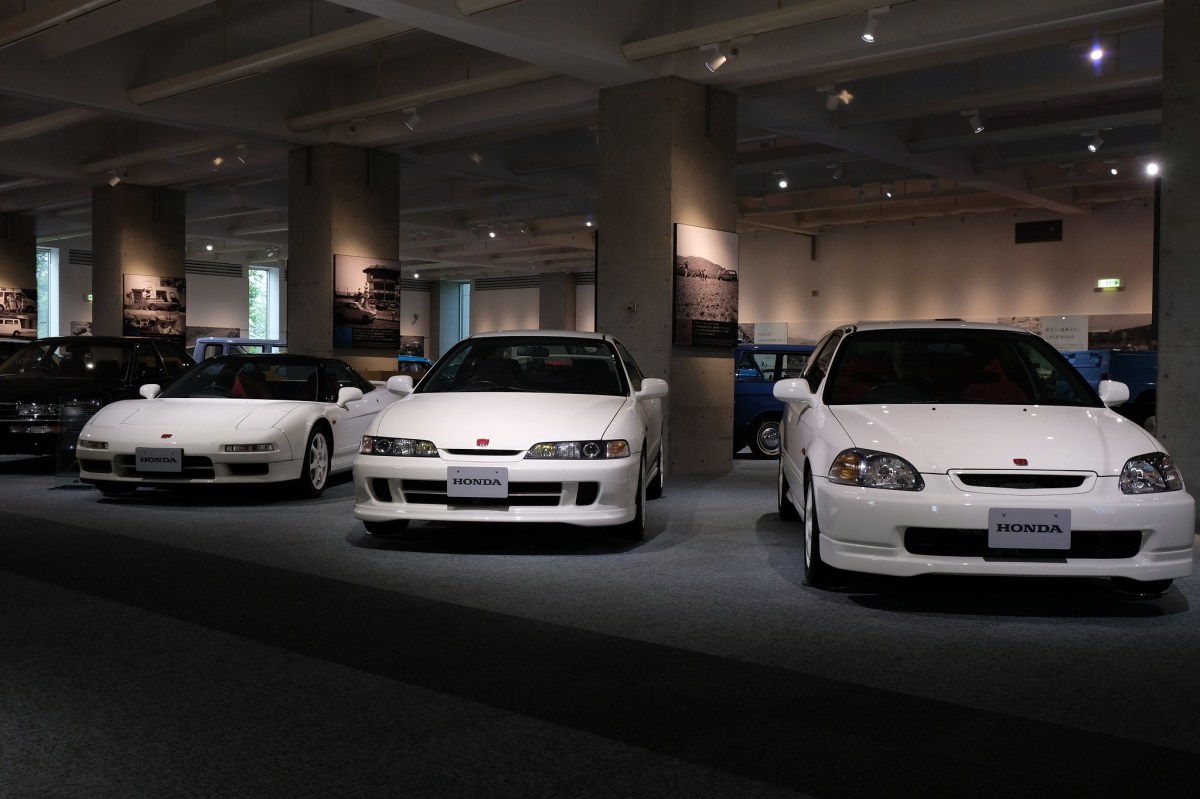
One of the things I love the most in life is to grab the car keys and go on a drive. Whether a road trip or a quick blast on some back roads, it’s something I consider a freeing, very zen experience. Especially once the weather has turned nice in spring and summer, when you can put the windows down a bit and enjoy the sunshine and some tunes. You know, in real Outrun style.

I found myself with some free time and decided to take a day to hit the road and go to Twin Ring Motegi and the Honda Collection Hall museum. Why head up to Motegi? I’ve never been, and visiting the Collection Hall sat on my to-do list for years. It’s also a location that’s quicker and easier to get to by car than train (about 3.5 hours each way by transit, 2 hours and change driving). So, in my estimation, a good day’s drive up and back.

Setting out from home and heading through the city reminded me how little I enjoy driving the shutoko. Tight two-lane roads with zero room for mistakes, cars entering from either side, and plenty of changes from left two lanes to the right? It’s a bit stressful. Most of the journey is outside the city on highways that feel more like home, so it was a matter of heading north to Mito and following the directions from there. I borrowed a Honda Fit from the car share service — a Toyota isn’t exactly the appropriate option! — and I remain surprised how well those B-class compact hatchbacks handle highway duty.

Arrival at the main gate is when the real world comes back into focus. After fumbling to get my mask back on while in the car, the very kind staff member at the gate asked where I was going, gave me a spritz of hand sanitizer, and also took my temperature. Up around the corner was the Collection Hall, and parking was plentiful given it was a quiet June Monday without any events going on.

The whole first floor is dedicated to Honda’s earliest history, from the motorized dreams of founder Soichiro Honda (who got a start as a mechanic’s apprentice and was a ride-on mechanic in motor races before WWII) to the first vehicles to feature his name, including adapted motorized bicycles and motorcycles. The early machines — including 1960s Formula 1 cars and racing motorcycles near the entry — provide the base for the company Honda has become in the successive decades.


The second floor is full of Honda’s street vehicles — cars, vans and kei trucks on one side, motorcycles on the other. It’s full of Japanese models dating from the mid-1960s through the 1990s. There’s a range of vehicles as well, showing Honda’s slow but confident march upmarket, from kei cars to the CVCC Civic, to mid-sized sedans, and eventually to the Type R trio seen above. If I have one complaint about the collection I saw, it’s that it is missing a few important models from the 2000s forward — no Fit is inexcusable (especially in the context of it being Honda’s first top-seller in the Japanese market), and no new NSX seems like a big oversight as well.

The third floor is the home of the racing machines, both four wheels and two. Honda’s long participation in Formula 1 is well represented, with a trio of the 1980s race-winning, flame-breathing turbocharged monsters taking place of pride in the setup.


Again, it’s hard to find too much fault, but there are certainly some newer vehicles which could find a home in the Collection — I’m thinking Takuma Sato’s Indianapolis 500 winning car would make a great addition, were they able to wrench it away from the team owner! If Max Verstappen is able to meet his expectations in a Honda-powered Red Bull in Formula 1, I wouldn’t be surprised if one of his cars wound up in the museum in the future too.

A nice surprise was the racing bike collection on the other wing. One small benefit to the size of the motorcycles is many more of them can be packed into the same space! And with Honda’s foundation in motorsports coming from high-level motorcycle racing — the company first challenged at the Isle of Mann Tourist Trophy event in 1959 — there’s plenty of choices to see.

One of the cool things about the motorcycle history on display is to note just how innovative and willing to try outlandish ideas Honda has been, which manifests itself as some real oddities in the collection. The above engine — Honda’s workaround for the four-piston rule in the motorcycle Grand Prix class — is my favorite example. Built for the 1979 NR500 racer, it used oval-shaped pistons, doubled connecting rods, and eight valves per cylinder (!!) to effectively turn a V4 into a V8, and attempt to get the four-stroke engine to be competitive in a form of racing where two strokes had been dominant for ages.


As a geek for various forms of Japanese motorsports, I was excited to see some of the other old racing cars on display — the Le Mans 24 Hours and JGTC-spec Honda NSX racers, an Accord touring car — and it definitely played to my childhood to see a Target-Ganassi CART Indy car in its full glory as well. Again, they could bring in some newer stuff as well, but as a ’90s kid I’m more than happy to live in nostalgia. After all, it’s the point of the museum!


After taking plenty of photos (and making a quick detour through the gift shop), I went back to the car and took a quick turn up the access road to see the circuit itself. I know from my own video game experience it isn’t the greatest layout for a road course, but it seems like a great place to spectate from — the big grass banks provide a lot of visibility, and the access around the track seems well done. I’ve also been to Fuji Speedway, and it’s a nice place to wander around and see a race from as much as it is a good place to drive as a circuit. Turns out that nice facilities are a good thing at a race circuit!

And with a hot afternoon drive back into Tokyo, that was it for my day out. It was worth the time and effort to get out of the house, drive through five different prefectures, and cross something off of my list. I still would love to come back and see a race there (the MotoGP Japanese motorcycle GP is hosted at Motegi, as are domestic Super GT and Super Formula races) and at the least it’s good to know how long it should take to get there and back.
For those that want to see the full set of photos, the rest are available here on Flickr.
 Doug Bonham Dot Blog