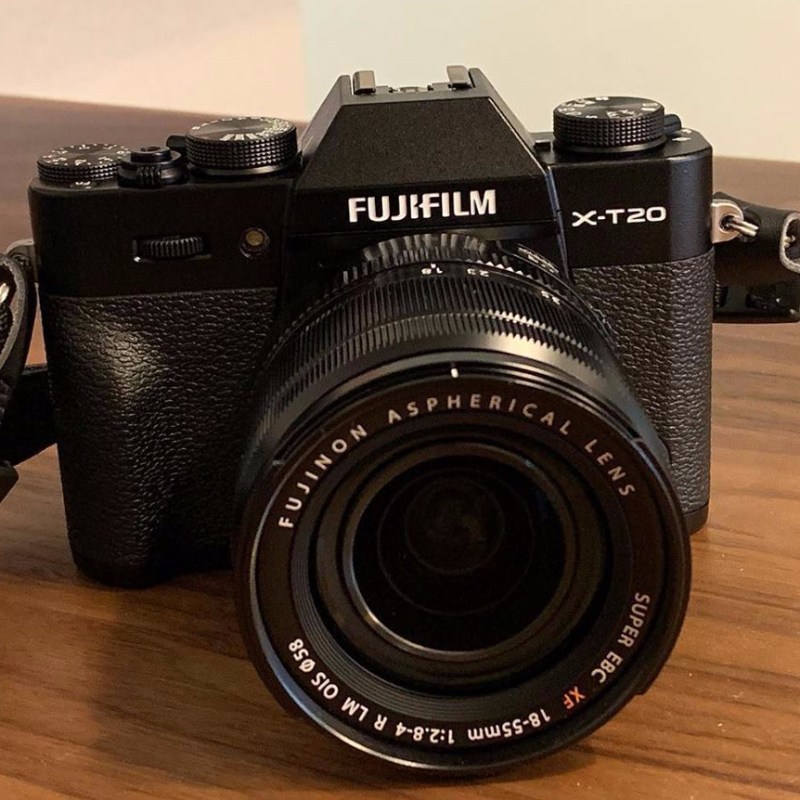
I’ve made a pretty major life change recently: I jumped from a solid 10 years of Canon cameras to move over to Fujifilm’s X series.

The non-photographers may struggle to understand the implications. My wife, for one, tolerates my geeky enthusiasm over cameras and glass despite not really understanding what all the fuss is about. And beyond wanting to get my thoughts and justifications out of my head, I figured some of you may wonder why people get so invested in companies and systems while also taking photos.
The first point to grasp with photography is that changing companies is more than just buying a new TV — it’s more akin to changing from Windows to Mac. This is because camera gear is mostly non-interchangeable — lenses bought for one camera brand generally don’t operate on another. The only things I have interchangeable are my SD cards for memory. Given those differences, it’s easy to see how brands (and brand loyalty) become the fault lines upon which photography dorks pitch their discussions and arguments.
So with that background, know that until 2019, I’ve been a Canon (mostly EOS) shooter. I bought the Canon Rebel XT back in 2008, I replaced it with the Canon 60D I’ve used since late 2011, and just last year I bought into Canon’s EOS M series in with the EOS M3, a smaller camera that still has interchangeable lenses and could use some of the lenses I’d picked up for the 60D. It was an excellent little tool, and I’ve enjoyed carrying a camera every day to work.
So what changed? I started to find the limitations in what Canon is offering.

The little EOS M3 is Canon’s entry in what’s called the mirrorless camera market. These are cameras built with a smaller body design than SLRs, but are still made with high-quality image taking in mind. That said, the M3 was lacking some of the features that make taking photos with bigger cameras so nice — in particular, a viewfinder. The other primary shortcoming I found was the lack of EOS M lenses. I bought the camera together with the 22 mm f/2 lens, which wound up being the best of what I used.
I enjoyed the compact size for such a powerful tool, but not the lenses available for it. So I looked at the landscape and decided that Fujifilm’s X series of cameras and lenses was the best place to move to for the future. I picked up a Fujifilm X-T20 and have loved learning about this new system and making interesting photos with this new piece of gear.

There are a number of other mirrorless camera systems, but three major reasons drew me in to the Fujifilm landscape. The first is the variety of camera and lens choices; compared with Canon’s EOS M range, there’s a much bigger range of excellent lenses available. The second is the controls, which on Fujifilm’s X series are much more like old film rangefinders — manual dials for individual settings replacing the jog dials on DSLRs. The last reason is the film simulations and quality of JPEG images — Fujifilm draws on its film legacy to create processing filters which create beautiful images without hours of Photoshop work afterwards.
That’s what I’ve found to be true in the last couple of months of use. The X-T20 is a joy to use; since I’m using this small camera explicitly because I enjoy turning dials and having an analog experience, this has been an excellent step up over using an iPhone. The X-T20 is also a more capable camera than I had expected; I didn’t buy it for action photography like sports or auto racing, but it’s entirely possible to use it as such. The combo of lenses I have (the 18-55 f/2.8-4 and the 27 f/2.8) are both sharp, high-resolution pieces of glass that allow me to craft some excellent photos. And I’m loving the Film Simulations, which let me easily adjust how vibrant or muted the color palate of an image I’m looking to capture.

It’s all a long-winded way to say: I’m enjoying the hobby, I’m enjoying the new tool I have at my disposal, and I’m excited to have a new set of tools I can use and learn to grow with. A review of the X-T20 on tech site The Verge is subtitled “Love, Rekindled”; I would heartily agree. Photography isn’t always about the tools you have, but they do play a part. With this new tool, I’m enjoying
 Doug Bonham Dot Blog